

The Contract Before the Mine
Brazil reported 21 million tonnes of rare earth reserves for 2025. Neither the Serra Verde offtake nor the POSCO-Caldeira memorandum requires separation in Brazil.

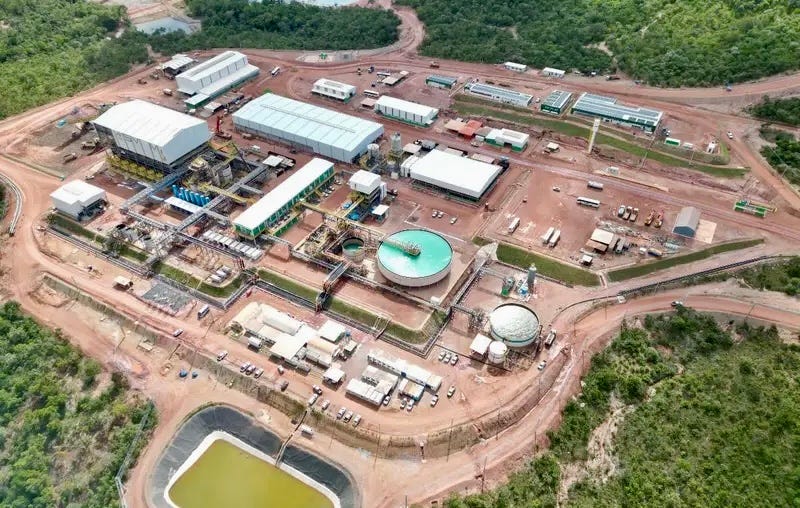
Black Paper: The Contract Before the Mine
The Ground
In the 1840s, Peru discovered that the most valuable thing it owned was bird droppings.
Off its coast sat a chain of arid islands where seabirds had been depositing nitrogen for thousands of years, undisturbed by rain. European agriculture had found nothing comparably potent at commercial scale. Peru controlled the deposits. What Peru did not control was a merchant fleet, a distribution network in Liverpool and Hamburg, or direct access to the credit markets that could advance cash against a cargo not yet loaded.
So Peru signed consignment contracts. Merchant houses in London, most famously Antony Gibbs and Sons, took the guano on consignment, advanced money against future shipments, arranged the vessels and sold into Europe. Peru received revenue, and a great deal of it.
Peru owned the islands. The merchant houses controlled the route to market.
The collapse that followed had several authors. Borrowing ran ahead of receipts. Much of the windfall was consumed by imports, debt service and infrastructure built at unsustainable cost. The richest deposits were exhausted first. The contracts did not cause the default. They revealed where the durable position sat. By 1876, Peru was in default. The commercial network remained abroad.
A deposit is latent value. The conductor is the contract connecting rock to an industrial buyer: who advances capital, who absorbs price risk, who receives the output, and which jurisdiction governs the step where ore becomes a component. Albert Hirschman’s National Power and the Structure of Foreign Trade supplied the frame in 1945. Trade becomes political power when the cost of interruption is asymmetric. In rare earths, that asymmetry can be assigned before production begins.
Which brings us to Brasília in the last week of July 2026.
The president of South Korea, Lee Jae Myung, arrived on a state visit. On 27 July, the two governments issued a Joint Statement on Critical Strategic Minerals through Brazil’s Ministry of Mines and Energy and Korea’s Ministry of Trade, Industry and Resources. It calls for cooperation across the full value chain, including technology transfer, local processing and value creation, while affirming Brazil’s sovereignty and policy autonomy.
That is the strongest evidence against a simple extraction story. It also marks the limit of what occurred. The statement does not bind a tonne of material or a separation plant to Brazilian territory.
Within the same visit, POSCO International signed a memorandum with Meteoric Resources covering the Caldeira project in Minas Gerais. Under the outline terms, POSCO could take up to 30 percent of Caldeira’s rare earth product for as long as seven years, acquire equity in Meteoric, and help the company approach the Korean export credit agencies KEXIM and K-SURE. Proposed pricing would initially reference the Asian Metal Index. The memorandum also contemplates cooperation on downstream activity inside Brazil. Meteoric released the terms to the Australian Securities Exchange on 29 July 2026 and published Caldeira’s definitive feasibility study on 31 July.
The memorandum is nonbinding. The study does not finance a mine. Caldeira has not reached a final investment decision.
That is precisely why it matters.
The mine does not exist. The industrial system seeking access to its future output is already being organized.
Two months earlier, on 21 May 2026, POSCO International signed an agreement in Washington with ReElement Technologies to establish a joint venture for an integrated rare earth separation, refining and permanent magnet complex in the United States. The planned investment is USD 200 million, with POSCO as majority holder. The first phase targets roughly 3,000 tonnes of separated oxides per year, followed by an expansion to 6,000 tonnes, with mass production targeted for 2028. It is a planned facility, not an operating one.
Read the two announcements together: Brazilian geology. Korean coordination. A planned processing complex in the United States. Allied industrial demand.
The announcements do not prove that Caldeira’s output will feed the American complex. They show something more structural. POSCO is assembling access to resources and downstream capacity across allied jurisdictions.
Serra Verde supplies a second and more direct example. On 23 July 2026, USA Rare Earth signed definitive agreements with Carester, a French specialist in rare earth separation. The agreements give Carester access to USA Rare Earth’s feedstock sources, including Serra Verde, while giving the American company access to Carester’s engineering knowledge, intellectual property and a portion of future oxide output. The acquisition of Serra Verde remained pending on 10 August, and the announcement disclosed neither a dedicated volume from Brazil nor proof that material had moved to France.
The qualification matters. A possible route is not a physical flow. But the route is being organized while Brazil’s domestic industrial conditions remain declaratory.
The missing step is separation. Rare earths emerge from the ground as a mixture. The seventeen elements are chemically similar, which is why they often sit together in the same rock. Pulling them apart requires repeated solvent extraction circuits and accumulated process knowledge. Financing the plant requires something different: a buyer willing to sign before it exists. Mining, beneficiation and concentration are industrial work too. But separation is the point where geological advantage begins to become industrial power, and it is the step the alternative chain has been least able to build.
That hinge is where geological scarcity becomes financial dependence, and where jurisdiction begins to matter more than ownership.
Brazil holds the world’s second largest reported rare earth reserve in the latest USGS estimate. That fact describes geology. It does not determine who finances the plant, receives priority over its output, or controls the jurisdiction in which mixed material becomes separated oxide.
Call the missing capability contractual sovereignty: the power to use finance, offtake, approval and law to decide where a resource becomes an industrial input. The thesis is narrower than resource nationalism. Rare earth power accrues less to the state that reports the reserve than to the state willing to absorb price and demand risk, then use the contract to allocate separation. Brazil can still change the route, but its leverage declines as those commitments become binding.
The contest is not between sovereignty and foreign capital. It is between capital admitted with a domestic industrial condition and capital admitted without one.
The full thesis continues below the line: the mechanism, the scenarios, who gains capacity, who loses it, what to watch, and what would break the reading.
One subscription opens the full archive.
